- Chutzpah!
Our TinEye friend Reg Braithwaite nails it with his tweet this morning which brought roars of laughter to our office:
But all hilarity aside: it seems that SixDead Entertainment (based in Montreal!) has simply ripped off our (awesome) TinEye robot. We understand. TinEye is an awesome robot, he is cute, steely, has great vision, works hard and is really powerful at searching for images. We understand how our TinEye robot could also make a fantastic bug squashing robot, but really we would rather our robot stayed away from bugs all together. So SixDead Entertainment: please stop using our TinEye robot before we send out the blood hounds (they won’t be very friendly, as opposed to our TinEye robot).I know you guys want to be known for “working hard to become well-established makers of mobile games” but I think we need to start with the basics here: not stealing other company’s characters? Do we have a deal?
TinEye and bugs: TinEye does not look happy. This is not the reverse image searching he signed up for!
We also don’t really like what @SixDeadGames has done to our poor TinEye robot above. Where are his arms? Perhaps you would like us to send you some high resolution files?
I think we just did. Catch you that is.
No. But we would like you to solve this little challenge instead: Remove our TinEye robot from your game and replace it with another robot – preferably not stolen from anywhere else? Deal?
- TinEye Multicolor Search on Hacker News
Well, good morning! Always nice to wake up to Hacker News love for our multicolor search!
If you haven’t tried our color search, go ahead and try it now. Warning: this is highly addictive! We also release a color extraction tool whereby you can extract all the colors present in an image, give it a whirl in our lab as well. Color search 101 and color extraction 101 cover the basics of the color search and extraction you can use in the lab and the API has been released too, we call it MulticolorEngine.
Happy searching!
- The story behind the TinEye robot
Many of our TinEye fans have asked us about the history of the TinEye robot, if the robot has a name, how was it created? and if TinEye itself was inspired by Brandon Sanderson’s Mistborn trilogy (it was not). So we thought to start off the new year we would reminisce with Stephen DesRoches about creating the TinEye robot. We invited Stephen to tell you the story from his designer perspective.
We love robots, machines, and all things mechanical. In fact, our TinEye office is filled with mechanical friends! A little history: back in 2000 when we were brainstorming cool names for our image recognition technology, it was no surprise that robots came to mind. Not just any robots, but those awesome tin toy robots of yore. Yes, futuristic robots trump our human abilities in so many ways: their tin arms are stronger, their tin brains are faster, and their ‘tin eyes’ are keener… Et voilà, the birth of TinEye! Well not really, as when we registered TinEye in the year 2000 – oh that has a nice ring to it – there was no TinEye, no reverse image search engine and no image recognition breakthroughs yet. There was a team, excited about changing the world of image search, and the rest as they say is history! So grab a coffee and let’s journey back in time with Stephen.
Talking about robots
It was 2003 when I first met Leila and Paul during a demo of their pretty amazing image recognition technology. The idea of searching for images with other images was a new concept for me but as this technology advanced and we (silverorange and Idée Inc) became friends, it was not long before we were working together.
Fast forward to when TinEye was being developed and prepared for the world stage, I was given the opportunity and challenge to create a mascot, a logo, and an identity for the service: reverse image searching. This brand needed to represent speed and efficiency. It also needed to be friendly and have a great personality. TinEye’s reverse image search was magical and I needed to create a brand to impart that magic. Given the team’s love for robots, magic and speed, we all very quickly converged on a robot. But what kind of robot?
Drawing a robot
TinEye is a fun brand but a mysterious one. While fun — it’s not childish. It’s fast, but comes with a level of mystery. Most of us could not explain how the TinEye technology works (well of course except the engineering team). We just accept and expect that it does. So how can we illustrate all of this with a single mascot brand?
The sketches
Starting is always difficult. I can spend days simply thinking about possibilities before ever picking up a pen. As a first step, I allow ideas to come and go while randomly throwing everything down on paper. Here are some of those initial ideas.

Quick drawings
And from that long list, we start to eliminate. Everything that doesn’t work for any reason at all has to go. One round at a time, we narrow the potential candidates down.

From round 1, some of the robots we had a hard time eliminating included these, specially the sorting robot at his desk:
Our round 2 favourites included:Selecting just one
After much debate, the speedy one wheel robot won us all over. It was time to focus and expand on that single concept. How would this robot look in full color?

Adjustments and final revisions
The problem with the robot above was that he didn’t look fast. He was heavy looking missing the goals of speed and efficiency. Below is the finalized robot. With small adjustments to a slightly more football-player-like shape, the slimmer and lighter colours were necessary improvements.
Speed? Yes. He could out run all of us.
Efficiency? Yes. Flexible rubber-like arms great for picking images.
Magical? Yes. How do the floating parts stay together?
Friendly? Yes. Well, he sure doesn’t look evil.
Personality? Yes. Loads of it!
Playing with emotion
The eyes are very powerful. The entire mood of an illustration can be altered by changing only the eyes and nothing demonstrates this better than the Pixar film Wall-e. A story without words but full of emotion. This alone provides the opportunity to use the robot in unique ways throughout the TinEye site.

Dissecting the illustration
At the root of all illustrations, it’s simply a stack of individual shapes (mostly created with the pen tool). Here is a look at all those layers and a fun way to see how TinEye was created.

TinEye Services for Business
Now that we look back at 2012, We spent the better part of the year working on TinEye Services for Business. This gave me the chance once again to experiment with many more fun story lines… and colour.


TinEye labs
And of course, TinEye Labs, a place to show off current and future technologies and projects.

A diversion
If you know the TinEye team, you will know that they are super friendly to wildlife and in addition to robots have a passion for animals. This is of course awesome when your office includes a garden where wildlife can be observed, but perhaps not such a good thing when you are building a new product brand. In the midst of our robot designs we decided — as a team — to experiment with an owl.
In design – very much like software development – going from point A to point B is not always done through a clearly defined road. On the path to the TinEye robot, our strongest alternative contender was an Owl. To create the owl – there are many types of owls – we started by drawing a series of owls and eliminating the ones we did not like or were difficult to build into a character. A lot of work and efforts but this was necessary for consideration but proved and confirmed our robot was the right choice. Here is the mascot that could have been TinEye. We can’t imagine TinEye not being a robot!

- MulticolorEngine Lab: Get my color – or color extraction
MulticolorEngine, the API powering our color search lab is now available for licensing. You have probably already played with our color search lab and already experienced addictive color searching but if you haven’t give it a whirl today.
This API can be integrated with any image search collection to allow users to search by colors. Well suited for e-commerce and image centric website and requiring no technology infrastructure changes, this API’s features include: the ability to index images by color, search by color as well as extract colors from a single image or a series of images – amongst many other features.
Today we would like to feature MulticolorEngine’s color extraction feature. To showcase this feature, we created a lab that allows users to extract colors from their images in real time. Drop by the lab, play with the feature and let us know what you think; we would love your feedback (link to contact form).
Using this MulticolorEngine lab you can:
- upload an image
- drag and drop an image
- or provide a URL to view the colors contained in your image.
MulticolorEngine will display a color palette for all the colors identified in your image. Color extraction works for JPEGs, PNGs and GIFs. Colors are displayed in RGB or HEX values.
and since this week is shark week:
And make sure to click on the colors on the generated color palette for a surprise multicolor search!
Shark photograph (c) by IVES.one
- Color search to make you smile!
It has been a busy few months in the TinEye HQ!
Our TinEye APIs are finally out of the oven and ready to take for a spin – we will talk about these another time – as today I would like to tell you about one API: MulticolorEngine. This is one of our favorite APIs and once you have played with it, you will join our fans!
Of course we are biased but we believe that MulticolorEngine is very likely the best color search engine in the world :)
Some of you may remember that a while ago we released a color search lab. It was our playground to use our color search technologies and figure out all the kinks of a color search API before we introduce it to the world. We basically sat down and ate our own dog food to wrap up development of our color search API. This new color search lab is powered by our new MuticolorEngine API. And you will get a pretty good feel for what this API by visiting and playing with the new lab.
The color search lab searches a 10 million creative commons image collection from Flickr. Of course you could integrate the MulticolorEngine API with any image collection and search it by one or more colors.
Now let’s step you through searching by color in our lab.
Let’s start by picking a single color. Summer green! (we made the color name up by the way!):
But what if you felt like a little orange? in addition to the green?
And how about some yellow to enhance that summer green and orange?
Neat? But what if you wanted less green and more orange? Well you would simply need to move up the color dividers and presto!See how our color distribution changed:
From:
To:
There are a few ways to alter the color combinations you have selected: by using the slider and just changing the percentage of color in each color selection or by simply adding more of a single color. If for example you had a green and orange combination and you wanted to see what would happen if you added more of the same orange: all you would have to do is add more orange and continue until the desired results start showing up.
Continue adding colors to your selection and MulticolorEngine will continue fetching the images that contain your color selection.
But suppose you no longer love your orange color selection?
Just click on the trash can and it is gone.
But now let’s say you don’t like the current shade of red you have selected. We have a solution for that as well – we know how attached people are to very specific colors! Click on the color wheel icon to bring up a full color wheel and select your desired color.
Change the red and get a new set of results:
As with any new release, there are still lots of enhancements and features we would like to add and we would appreciate your feedback.
Got a few minutes, well, play! and let us know what you think before we get to polishing this release.And oh, one last thing: we have heard that sometimes you have a color code and would like to search for exactly that color, without going through an interface. Well you can do that via the page’s URL:
Notice the above highlighted code? That’s a hex color code and you can alter it to whatever hex RGB code you like!
MulticolorEngine: hand crafted in Toronto (Canada) by the TinEye team and a lot of caffeine (and sometimes beer).
- MulticolorEngine: a color search API!
It is finally here!
MulticolorEngine, the API powering our color search lab is now released. You have probably already played with our released color search lab and already experienced addictive color searching but if you haven’t, give it a whirl today. In our lab, you can search a 10 million image collection by colors. Not just one color!
And let us know what you think. Would love your comments.
And if you need a handy dandy little guide for color searching using the lab, we’ve got that too!
What’s exciting today is that our color lab is now completely powered by our MulticolorEngine API – which (drum roll) has now been fully productized and is available for licensing.
MulticolorEngine = Search by colors in API form
Our MulticolorEngine API can be integrated with any image search collection to allow user to search images by colors. Well suited for e-commerce and image centric website and requiring no technology infrastructure changes, this API’s features include:
- A color indexer that extracts and indexes all the colors in a collection of images. No manual tagging/keywording of colors is required.
- The ability to search using one or more colors, or to search for images matching the color palette in another image.
- A color palette generator which will find all the colors present in a single image, or a collection of images. Using this feature you could display all the colors you have available in sofas, chairs and tables, and then let a user filter their search to only display green chairs.
- Support for structured meta-data search. Allowing you to build interfaces that can, for example, find all products priced less then $50.00, in the ‘shoe’ category that most closely match a particular shade of yellow.
- Arbitrary meta-data searching. So if you have multiple collections, tags, and prices, these attributes can be searched for along with up to 5 colors.
- Support to provide a count of the number of products you have that match a particular color, allowing users to easily browse your collection by color. For example you could let users know that you have 32 different varieties of red, 16 yellow, and 66 black shoes for sale.
- Easy integration with your existing search technologies and development infrastructure.
- The ability to ignore solid or transparent backgrounds in images. This is critical for product images where the background of the image should not be considered a color during a product search.
Right now, you probably need to stop reading and head over to the lab to start color searching!
In addition to our MulticolorEngine API and the color search lab, we thought it would be fun to build a little lab around one of our API feature: the ability to extract colors from an image. This new lab takes your image and gives you a color list or color palette. It will display a color palette for all the colors identified in your image. Color extraction works for JPEGs, PNGs and GIFs. Colors are displayed in RGB or HEX values. Give it a try. We would love your feedback. This of course is just one of the many features included in the MulticolorEngine API.
And that’s not all: how about shopping for shoes by colors?oh well, for that you will need to wait until next week when we release a little Zappos lab that will allow you to search products by colors!
With this API release, we are excited to continue building our vision for an integrated image recognition platform. So please stay tuned for more API releases and news in the coming weeks. MulticolorEngine is brought to you by the tiny TinEye team. If you are interested in bringing more image search and recognition goodness to the world, join us. We are hiring.
MulticolorEngine was built with love and caffeine in Toronto (Canada).
And if you would like to find out more about MulticlorEngine here is all you need:
- Details and pricing
- Documentation
- Color Search and Extract Color Lab
Happy searching!
- The internet map illustrated by traffic and user activity.
Russian data-visualisation designer Ruslan Enikeev has mapped 350,000 websites and 2 million links from 196 countries according to levels of activity and the other sites visited by their users. Each website is represented by a circle. The size of the circle is determined by website traffic. The color of the circle is determined by countries (for example US is blue, Canada is purple). The gaps between the circles are determined by the frequency the users go from one site to the other.
From Ruslan Enikeev:
As one might have expected, the largest clusters are formed by national websites, i.e. sites belonging to one country. For the sake of convenience, all websites relative to a certain country carry the same color. For instance, the red zone at the top corresponds to Russian segment of the net, the yellow one on the left stands for the Chinese segment, the purple one on the right is Japanese, the large light-blue central one is the American segment, etc.
Importantly, clusters on the map are semantically charged, i.e. they join websites together according to their content. For example, a vast porno cluster can be seen between Brazil and Japan as well as a host of minor clusters uniting websites of the same field or similar purposes.
Spot TinEye?
- Toronto GirlGeek: the algorithms edition!
I am really excited to be speaking at the next Toronto Girl Geek evening. I remember attending one of the first Girl Geek dinners in London in 2005. It was organized by Sarah Blow, the founder of Girl Geeks. That evening was pretty much magical: I met Robert Scobble and Maryam Scobble. I also met Hugh MacLeod, Ben Metcalfe, Henriette Weber Andersen and a lot of awesome attendees whose names I can no longer recall unfortunately! It was a surprising evening, full of technology discussions, blogging, changing the world conversations and great wine – I vaguely remember a wine sponsorship there! Next week the Toronto Girl Geek evening is all about Algorithms. And that’s of course something I am super excited about!
Not only am I speaking but TinEye will be hosting in our offices. I would suggest that you get a ticket, but I hear it is sold out! Can’t believe that there are that many people interested in hearing about algorithms!
Inspire more women and girls into a career in science, engineering or technology by supporting Girl Geek Dinners. Perhaps your company could host the next one?
- TinEye commercial accounts… the really-super-easy way
A while back we introduced a commercial version of TinEye: a paid search alternative for professional, commercial or high-volume users. While the free version of TinEye only allows you to do a limited number of searches per day and is for non commercial use only, the commercial version of TinEye allows you to purchase as many searches as you like–for commercial or non-commercial use.
We initially launched the commercial version of TinEye as an API only. Using it required integrating the TinEye API with your web service or application. However what our users may not know is that we also provide a user-friendly interface for commercial accounts.
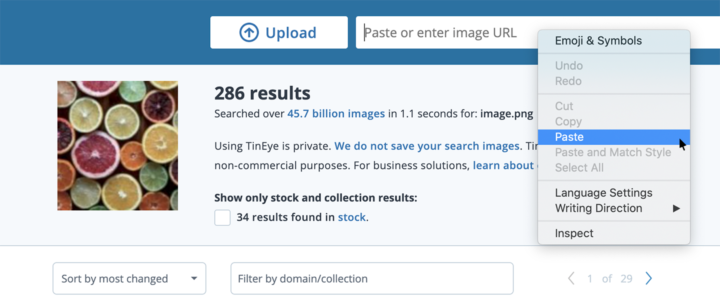
This means that you can create a commercial TinEye account and use it to search for images in the same way that you are used to doing at tineye.com. Upload an image, or cut and paste a URL. There is even a separate browser plugin for commercial accounts so that you can right-click on any web image to search for it.
So let’s get started! Here is a step-by-step tutorial on how to get you or your company set up with a TinEye commercial account and start searching… the easy way.
1.
Go to the TinEye commercial website. This is different than the regular TinEye website, and all of the commercial activities are completed there, including searching and checking your account.
2.
Click the Sign up tab to sign up for a commercial account. Fill in all of your details, and if you are using TinEye commercially, don’t forget to provide the URL for your company website. You will receive an email verification as soon as you’re done.
3.
Check your email for a message from TinEye and click the verification link! You will be asked to log in with the email and password that you just used to sign up.
4.
Once you’re logged in, you’ll find yourself on the Welcome page. Don’t click away yet! There’s some good-to-know stuff here to help get you started. You can get back to this page from wherever you are on the site by going to About > Welcome (but you need to be logged in!).
5.
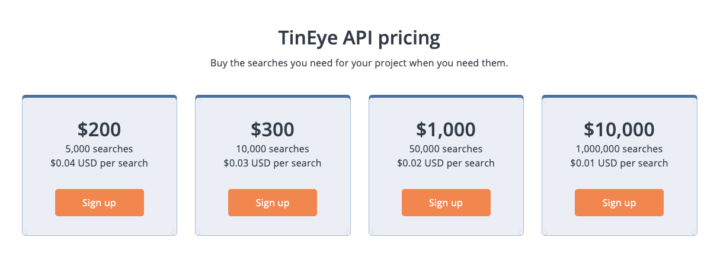
Before you can start searching, you need to buy a search bundle (you need to be logged in to actually buy a search bundle, but you can see the pricing even if you’re not). Transactions are handled via PayPal or credit cards; as soon as you’re done you’ll be directed back to your account summary page on our site, which will show what you just purchased.
6.
You’re all set! Click on the Search tab to get started. Then simply search the way you would normally do on tineye.com. Upload an image from your local drive to search for it, or point to a web image or web page by pasting the URL.
Bonus!
To make searching even easier, get the browser plugin for TinEye commercial accounts. It lets you right-click on any web image to search for it (currently available for the Firefox and Chrome browsers only). To install, go to the Search page and select the API plugin for your browser. Remember you can only see this page when you are logged into your TinEye Commercial API account!
Note: The browser plugins for the regular version of TinEye found at tineye.com/plugin will not work with your TinEye API account. You must install the commercial version to perform searches that will work with your prepaid search bundle.
And that’s it folks, happy searching!
- Rock on RHoK Toronto
We are super fond of hackathons in the TinEye HQ so when we heard about Random Hacks of Kindness Toronto was gearing up for its bi-annual event in June, we decided to land a hand as a sponsor. TinEye will be hosting RHoK Toronto for the opening night and we are excited to welcome you all in our TinEye HQ.
What is Random Hacks of Kindness?
Random Hacks of Kindness (RHoK) is a joint initiative between Microsoft, Google, Yahoo! NASA and the World Bank. The objective is to bring together subject matter experts around disaster management and crisis response with volunteer software developers and designers in order to create solutions that have an impact in the field.
“RHoK’s model starts from identifying, defining and refining problem definitions provided by subject matter experts and local stakeholders. This ensures that volunteer time is focused on solving real problems for real people.”
The mission here is of course to make the world a better place. :)
RHoK has hosted 4 global events to date, in 45 cities around the globe with over 4000 participants. During the RHoK 4 global event in December 2011, over 120 problems were addressed by 110 technology solutions. Solutions developed by the RHoK community have been used by organizations such as the World Bank, governments, emergency responders, and citizens.
As RHoK Toronto was gearing up for its bi-annual event on June 1-3, we took a peak at their planning ahead of the event on June 2nd. The first evening was the Pitch Night and Design Jam evening on May 15th which was held at Bento Miso a Queen West co-working space for tech and game developers. We listened to a number of pitches from participants. Each pitch was followed by a Q&A which allowed further definition of the problem to be solved and a bit of a dive into the issues at hand, and perhaps what an ideal solution would be. At the end of the pitch presentations participants joined the pitch (or problem) they were most interested in solving.
At the end of the evening the following problems (projects) were defined:
- a platform to record, transfer and review ultrasound images from remote areas in Nepal. This will allow doctors and trained nurses to review ultrasound images with the aim to reduce maternal mortality rates in remote Nepalese areas.
- Microcollaboration for journalists: InvestigateNet. This project would see the creation of a web based, social-enabled tool to help journalists anywhere – even with limited access to basic information technology — to collaborate and gain access to fundamental information, and foster deeper collaborations in the process.
- Water Voices: – a 3-part project that aims to improve First Nations access to water and sanitation through a geo-spatial water database, voice-to-SMS integration of the SMS platform and an open source CMS.
- Interactive mapping platform to overlay apartment inspection data in the city of Toronto with user and organization contributed data to engage communities and in campaigns for fair housing and to expedite repairs.
Register to attend RHoK and to view the schedule and follow @RHoKTO. We are looking forward to seeing the application roll out of production on Sunday!
RHoK Schedule:
Friday June 1st, 2012 – Reception!
Join us on Friday night. You will meet judges, participants, special guest and will get an opportunity to hear about the projects you will be hacking on during the wekend.
Where: TinEye 223 Queen St. E., Toronto, ON, Canada M5A 1S2
6-9pm: Meet & Greet with other participants (refreshments will be served)
Main Event! Saturday June 2 – Sunday June 3
Where: Centre for Social Innovation, Annex location: 720 Bathurst St, Toronto ON (see map here)
Saturday June 2nd, 2012
- Registration & Breakfast: 9:00 – 10:00am
- Introductions: 10:00-11:00am
- Hacking: 11:00am- 5:00pm
- First Day re-cap: 5:00pm
- Hacking & GameChangers Social: 6:00pm-9:00pm
Sunday June 3rd, 2012
- Breakfast: 9:00 – 10:00am
- Hacking: 10:00 am -3:00 pm
- Pitch Competition and Judging (and prizes!): 3:00pm-5:00pm
[RHoKERS photograph (c) Bento Miso]